

2026 Acura RDX vs 2026 Ford Explorer: Which SUV Fits Your Needs?
August 27 2026,
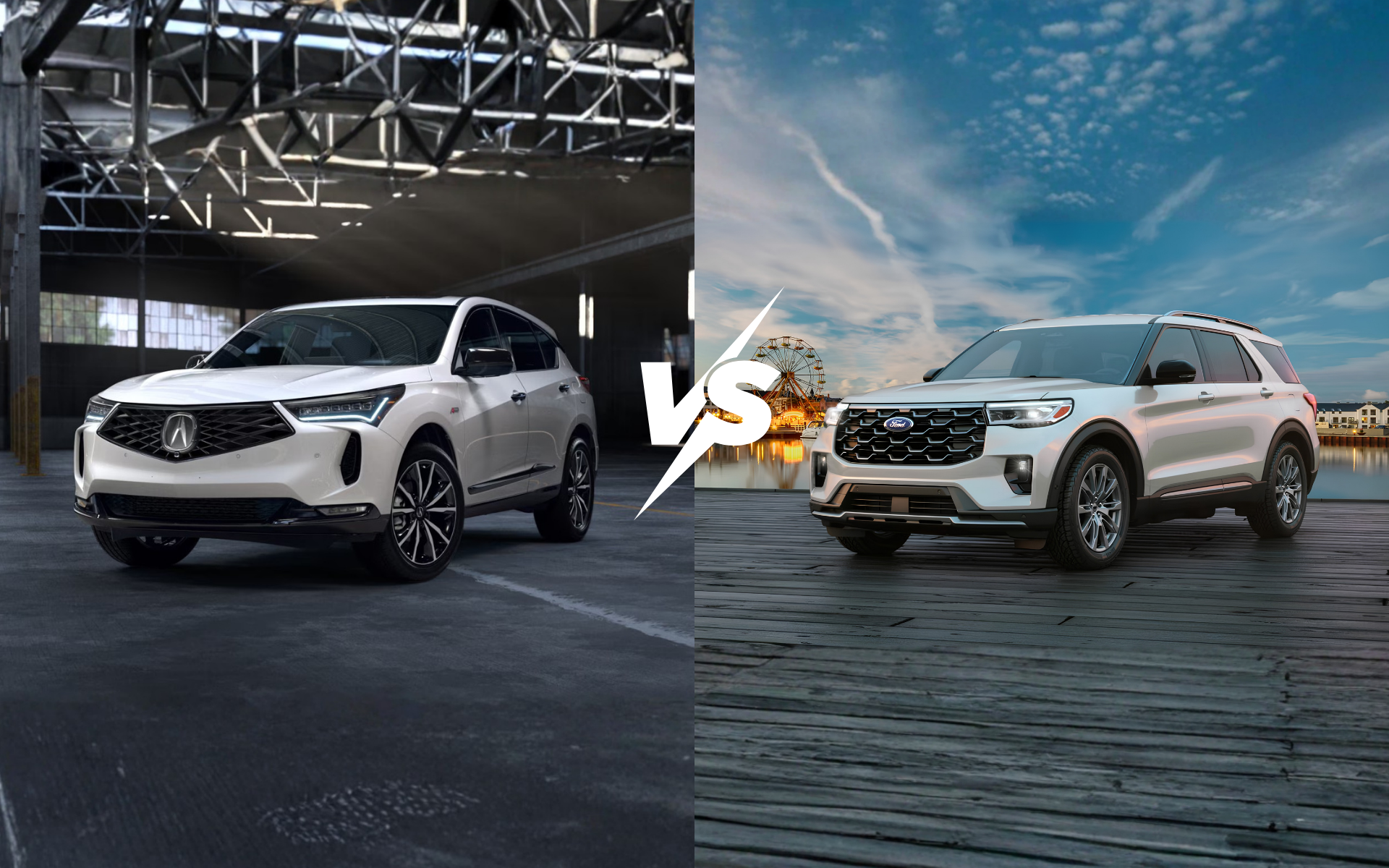
Choosing between two SUVs can be surprisingly difficult when they prioritise different things. The 2026 Acura RDX focuses on premium comfort, responsive performance, and a five-passenger cabin, while the 2026 Ford Explorer offers three-row versatility, substantial towing capability, and multiple powertrain options.
For shoppers in Markham and across the GTA, the better question isn't simply which SUV is bigger or more powerful. It's whether a refined two-row luxury crossover or a larger family-oriented SUV better matches everyday needs.
Performance: Refined Turbo Power or Maximum Muscle?

The RDX uses a 2.0-litre turbocharged four-cylinder engine producing up to 272 horsepower and 280 lb-ft of torque. A 10-speed automatic transmission and Acura's Super Handling All-Wheel Drive (SH-AWD) are standard across the Canadian lineup.
That combination gives the Acura plenty of usable power for commuting and highway travel. The generous torque output can also make acceleration feel more effortless when merging onto busy GTA highways.
The Explorer offers more powertrain variety. Its standard 2.3-litre EcoBoost four-cylinder produces 300 horsepower and 310 lb-ft of torque, while the available 3.0-litre EcoBoost V6 increases output to 385 horsepower and 415 lb-ft of torque. Both engines use a 10-speed automatic transmission.
The difference matters more when the SUV is fully loaded or towing. The Acura's turbo-four suits everyday driving, but the Ford's available V6 provides considerably more muscle for demanding applications.
AWD and Fuel Economy for Canadian Driving
Acura makes SH-AWD standard throughout the RDX lineup. The system is designed to distribute torque between the axles and help optimize traction and handling as conditions change.
The 2026 RDX is rated at 11.0 L/100 km city, 8.6 L/100 km highway, and 9.9 L/100 km combined in its standard configuration. A-SPEC and Platinum Elite A-SPEC models are rated at 11.3/9.1/10.3 L/100 km, respectively. Acura recommends 91-octane premium unleaded fuel, and the fuel tank holds 64.7 litres.
The Explorer's 2.3-litre EcoBoost is rated at 11.9 L/100 km city, 8.7 L/100 km highway, and 10.4 L/100 km combined. Choosing the 3.0-litre V6 increases consumption to 13.0 city, 9.3 highway, and 11.3 combined.
For a daily commuter, the RDX therefore has an efficiency advantage over the Explorer's standard four-cylinder configuration. Ford's trade-off is greater towing capacity and a larger three-row format.
Two Rows or Three? Consider How You Actually Travel

The RDX seats five passengers, making it well suited to couples, smaller families, and drivers who rarely need additional seating.
The Explorer is designed around three rows and can accommodate up to seven passengers, although some configurations with second-row captain's chairs seat six.
That distinction can quickly determine which SUV makes more sense. A family that regularly transports children, friends, or additional passengers will likely appreciate the Ford's third row. For households that rarely carry more than five people, the Acura's two-row layout keeps the vehicle focused on everyday comfort and usability.
Cargo capacity follows the same philosophy. The RDX offers substantial room behind its second row, while the Explorer adds flexibility by folding its third row when you don't need that seating.
Towing: A Clear Explorer Advantage
Towing is one area where the Ford has a significant advantage.
The RDX has a maximum towing capacity of 680 kg (1,500 lb).
The Explorer, meanwhile, can tow up to 2,267 kg (5,000 lb) when properly equipped. Ford also makes the Class III Trailer Tow Package standard across the 2026 lineup.
That difference matters if regular towing is part of the ownership plan. A utility trailer, recreational equipment, or larger load is much more naturally suited to the Ford.
If towing isn't on the agenda, however, the Explorer's higher capacity may not be enough reason to choose a larger SUV.
Technology: Premium Simplicity Meets a Larger Digital Interface
The RDX provides a 10.2-inch HD centre display, a digital driver information display, wireless Apple CarPlay and Android Auto, wireless smartphone charging, Wi-Fi capability, and Acura connected services. Higher trims add navigation and an ELS Studio 3D premium audio system.
The Explorer takes a more screen-focused approach. It features a 13.2-inch centre display and 12.3-inch digital instrument cluster, while Ford Digital Experience provides the central interface. Available technology includes wireless smartphone integration, a B&O audio system, and Ford BlueCruise hands-free highway driving.
The distinction is less about one model being technologically advanced and the other being outdated. Instead, Acura leans toward a premium, driver-focused environment, while Ford emphasizes a larger digital interface and family-oriented connectivity.
Safety Technology for Busy GTA Roads
Both SUVs offer extensive driver-assistance technology designed to support the driver during everyday travel.
Acura's AcuraWatch suite includes technologies such as Collision Mitigation Braking System with pedestrian detection, Lane Departure Warning, Blind Spot Information, Traffic Sign Recognition, and a multi-angle rearview camera.
The Explorer offers Ford Co-Pilot360 technologies, including Pre-Collision Assist with Automatic Emergency Braking, Lane-Keeping System, and BLIS with Cross-Traffic Alert. Available features include a 360-degree camera and BlueCruise hands-free highway assistance.
For drivers navigating Markham and the wider GTA, these systems can be useful during lane changes, congested traffic, highway travel, and parking manoeuvres. They remain driver-assistance technologies, so attentive driving is still essential.
Which SUV Makes More Sense for Your Lifestyle?
The RDX is the more natural choice for shoppers who prioritize premium comfort, standard SH-AWD, responsive turbocharged performance, five-passenger practicality, and a more compact footprint. Its 272-horsepower engine delivers strong everyday performance without the higher fuel consumption of the Explorer's V6.
The Explorer makes more sense when passenger capacity, towing, cargo flexibility, and powertrain choice take priority. Its available 385-horsepower V6, three-row configuration, and 5,000-pound towing rating give it capabilities the Acura cannot match.
Quick Comparison
|
Feature |
2026 Acura RDX |
2026 Ford Explorer |
|
Engine |
2.0-litre turbo four-cylinder |
2.3-litre turbo four-cylinder / 3.0-litre turbo V6 |
|
Max Horsepower |
272 hp |
385 hp |
|
Max Torque |
280 lb-ft |
415 lb-ft |
|
Transmission |
10-speed automatic |
10-speed automatic |
|
AWD/4WD |
Standard SH-AWD |
Intelligent 4WD |
|
Seating |
5 |
Up to 7 |
|
Max Towing |
680 kg / 1,500 lb |
2,267 kg / 5,000 lb |
|
Combined Fuel Economy |
9.9–10.3 L/100 km |
10.4–11.3 L/100 km |
Compare Your Options in Markham
Ultimately, the right SUV depends on how you'll use it once the showroom excitement wears off. If luxury, five-passenger comfort, standard SH-AWD, and efficient turbocharged performance are the priorities, the Acura deserves serious consideration. If a third row, stronger towing capability, and maximum power matter more, the Ford's larger format has a clear advantage.
A test drive is the best way to compare seating comfort, visibility, steering response, technology, and overall cabin feel. Visit Markham Acura to explore available RDX inventory, ask about current offers and financing options, and arrange a test drive with the dealership team.

